Over 2 billion logged-in viewers watch music videos on YouTube each month (YouTube, October 2025). Reaching your few thousand is a plan, not luck: a channel ready for the release, a launch that compounds, and ads aimed at fans like yours.
What has to be in place before you promote a music video?
Three things: the release delivered through a music distributor or label, the official video uploaded to a channel you control, and an Official Artist Channel that gathers your subscribers in one place. Promotion sends people to a watch page, and these steps make sure that page, its subscribe button and its view count are yours. Each one is free and takes days, not weeks, so do them before the ad budget is spent.
The step most artists skip: the Official Artist Channel. YouTube’s bar is low. You must “own and operate a single artist’s or band’s YouTube channel that is focused on the artist’s or band’s music” (YouTube Help, Introduction to Official Artist Channels, read October 2026).
You also need “at least 1 official music release on YouTube that has been delivered and distributed by a Music Distributor or Label”. YouTube does not take the request from you: “contact your label or distributor to request an Official Artist Channel”.
- Deliver the release through a distributor. The audio becomes an official release, which is the eligibility trigger, and it enters the catalog that Shorts creators pick songs from.
- Upload the official video to your own channel. The subscribe button, the comments and the view count then belong to you, and that is the page an ad will send people to.
- Ask your distributor for the Official Artist Channel. When it is created, subscribers from your topic channel and your existing channel are merged into it, so the count rises before a single ad runs.
- Keep the channel clean. An Official Artist Channel that takes a Community Guidelines strike “will be suspended and become a standard channel” until the issue is resolved.
Expect the subscribe button to vanish from your topic channel once the Official Artist Channel exists. YouTube moves it, and the subscriber count, to the new channel; nothing is lost.
How do you launch a music video on release day?
Schedule it as a Premiere and surround it with Shorts that link back to the full video. A Premiere turns a release into an event with a countdown, a trailer and live chat, and YouTube creates the public watch page in advance, so the link you post in the days before release is the link that becomes the video. Shorts built on the song send fans to that same page.
Why a Premiere: “A public watch page is created for your video to eventually premiere on”, and “the view count from the Premiere will transfer to the video afterwards” (YouTube Help, Premiere a new video).
| When | What to do | Why |
|---|---|---|
| 14 days before | Deliver the audio to your distributor; upload the video as a scheduled Premiere with a trailer | The watch page exists early, and the song becomes an official release |
| 7 days before | Post two or three Shorts cut from the video, using the official song from the audio picker | Each Short carries a link to the full video |
| Release day | Premiere at an hour your fans are awake, and sit in the chat | Reminders fire, and the chat gives the page its first comments |
| Days 1 to 14 | Run the video as a YouTube ad to fans of similar artists | The video is newest while the ad budget is working |
Shorts carry the link. “Consider linking your Official Music Video to Shorts featuring your track. A video link will appear under your handle on the Short.” The setting is in Studio under Content, Shorts, Edit, Related video (Shorts for Artists, YouTube for Artists).
Use the official song from the audio picker, not the raw audio in your file; YouTube’s tip is to “always use the official song from the audio picker”. The song page then links “to all other Shorts using your song and your Official Music Video”.
A Premiere gives the release a date. Shorts give it a doorway. Ads give it an audience.
Can you pay YouTube to promote a music video?
Yes. YouTube sells one kind of promotion: your video runs as an ad on YouTube’s own ad platform, before other videos, in the feed, above search results and in the Shorts feed, and you pay only when someone watches or clicks. Sprizzy runs that promotion for you through Google Ads. You pick the video and the artists you sound like, and it writes the ads, builds the audiences and launches them, from $50.
| Where the ad runs | What the fan sees | When a view is charged |
|---|---|---|
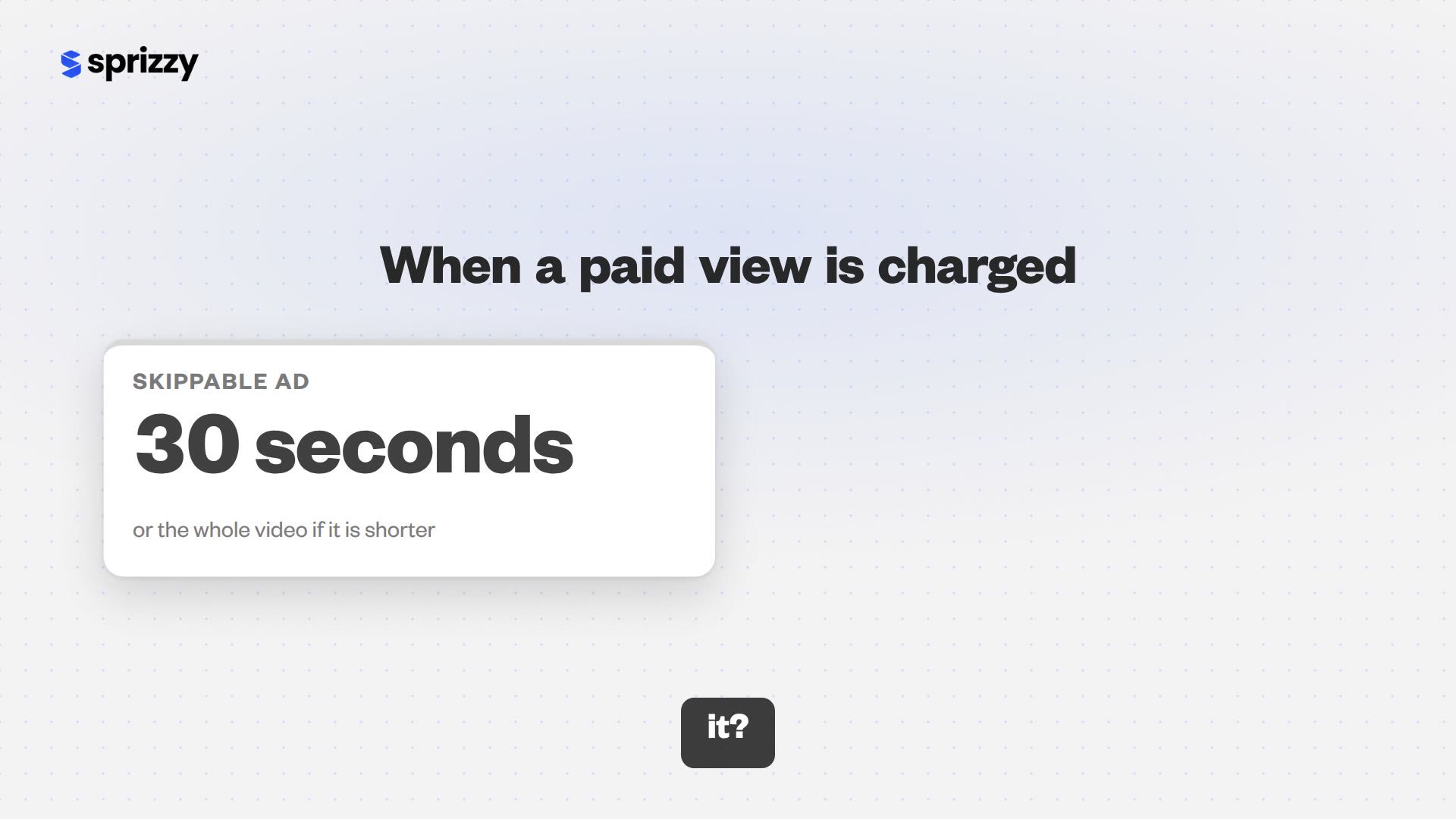
| Before or during another video (skippable in-stream) | Your video, with a skip button after 5 seconds | 30 seconds watched, the whole video if shorter, or an interaction |
| Home, search and next to related videos (in-feed) | Your thumbnail and title as a promoted video | A click to watch, or 10 seconds of autoplay |
| The Shorts feed | Your video full screen between Shorts | 10 seconds watched, the whole video if shorter, or a tap |
Those charge rules are Google’s own (Google Ads Help, Video ad formats, read October 2026). A fan who had a skip button for 25 seconds and kept watching is the viewer you wanted.
Organic reach is untouched. YouTube’s help page on promoted videos: “No, promotions don’t impact your channel’s or a specific video’s organic performance.” It defines Follow-on Views as “organic views you get when someone watches your videos after seeing your promoted content” (YouTube Help).
YouTube paid the music industry over $8 billion in the year to June 2025, and Lyor Cohen, YouTube’s Global Head of Music, wrote that “the twin engine of ads and subscriptions is firing on all cylinders” (YouTube blog, October 23, 2025).
Promote the official video, not a lyric video or visualizer, unless the official video does not exist yet. The ad, the Short link and the Premiere should all point at one page, so every view and comment lands in the same place.
How do you target fans of artists like you?
By naming the channels, videos and search terms your fans use, then letting the promotion test combinations. In Google Ads, channels and videos are “placements”, meaning “locations where your ads can appear on YouTube” (Google Ads Help, About placement targeting), and keywords can be layered on top. On Sprizzy you enter keywords and similar channels, plus location, age and gender, and it builds and tests more than 200 audience combinations from that list.
A worked example. Here is what a melodic rap artist from Atlanta might enter, and what each line turns into.
| You enter | It becomes | Who sees the ad |
|---|---|---|
| Five artists at your level and two big names in your lane | Placements on their channels and videos, plus audiences of their fans | People who just watched an artist you sound like |
| “melodic rap”, “new rap 2026”, the name of your sub-genre | Keyword targeting across search and related videos | People searching for your sound |
| United States, United Kingdom and Canada; ages 18 to 34 | Location and age filters on every audience | Fans in the markets your streams already come from |
The list is the lever. Fans of the big names are the pool; the smaller names sharpen it. If your streams come from three countries, set those three. A song in Spanish or Twi with the wrong countries set reaches nobody who would care.
Sprizzy’s automated optimization removes low-performing audiences every hour, and you can remove any audience yourself from the report, so the budget drifts toward the fans who keep watching. See how Sprizzy promotes music and what a promotion costs. Musicians on Reddit judge results the same way, by the fans who keep coming back: YouTube music promotion lessons from Reddit.
Add the channels your fans watch between releases, not only artists: live-session channels, reaction channels, beat channels, guitar lessons. A reaction channel’s audience is already in the habit of hearing new tracks.
How do you tell real promotion from bot views?
Ask where the views will appear in your YouTube Studio. Views from a real ad campaign land under one traffic source, YouTube advertising: “If your video is used as an ad on YouTube, you’ll see ‘YouTube advertising’ as a traffic source” (YouTube Help, Traffic sources). Bought views from a bot network have no ad behind them, so they can only arrive as direct, external or unknown traffic, and YouTube’s verification discards them.
The policy is explicit. Three lines from YouTube’s fake engagement policy decide the matter:
- “Page traffic found to be artificial will not be counted on YouTube and can lead to strikes on your account.”
- “If you get 3 strikes within 90 days, your channel may be terminated.”
- Content that “links to or promotes third-party services that artificially inflate metrics like views, likes, and subscribers” is itself a violation.
For an artist the cost is higher. An Official Artist Channel that takes a Community Guidelines strike is suspended and becomes a standard channel until the issue is resolved. The merged subscriber count and the artist features go with it.
Five questions settle any service in one email. The right column is what a seller of artificial traffic cannot answer.
| Ask | A real answer | A bot answer |
|---|---|---|
| Where will the views show in my Studio? | Under YouTube advertising in Traffic sources | “Direct”, “external”, or they do not know |
| What am I charged for? | A view a person chose: 30 seconds of a skippable ad, a click on an in-feed ad, 10 seconds of a Shorts ad | A fixed package: so many thousand views for a flat price |
| Can I see the targeting? | Keywords, channels, countries, ages, and which audiences were removed | A genre name, or nothing |
| How fast? | Live after review, spread across days | Delivered within hours |
| Can I pause or get a refund? | Pause or cancel any time; unused funds come back | No refunds once delivery starts |
A package priced per thousand views and delivered in hours cannot be an ad campaign. Google charges per view a person chose to watch, and real people set the pace.
Every Sprizzy view arrives through Google Ads and is counted by YouTube, so it shows in your own Studio under YouTube advertising. Here is how a promotion works; Sprizzy has run them for over 1.5 million channels since 2016.
How much should you spend, and for how long?
Start at $50 or $100 on the lead track, run it across the first two weeks of the release, and add budget to the audiences that keep watching. Sprizzy promotions are one-time payments with no subscription, can be paused or canceled at any time, and your first one comes with a money-back guarantee. Pricing starts at $50, with the budget set by a slider rather than a package.
- One promotion per lead track. An EP with three singles gets three promotions, each with its own audience, rather than one promotion for the whole record.
- Front-load the first 14 days. The video is newest, the Premiere chat is fresh and the Shorts are live; that is when an ad view is most likely to become a subscriber.
- Keep the back catalog moving. Auto-Promote gives every new upload its own promotion without you logging in.
What a view costs depends on country, genre and the video itself. The cost guide has current benchmarks and public tests, and this piece covers what a first $50 test should tell you.
Judge the promotion in Studio, not in the ad dashboard alone. Why paid views and Analytics differ explains the three counters, and whether ads hurt organic growth settles that fear with YouTube’s own words.
Recorded music grew to $31.7 billion in 2025, up 6.4%, with streaming 69.6% of it (IFPI Global Music Report 2026, March 18, 2026). The fans are there; the job is to be the video they see next.
Spend where the video is newest, split it by track, and let the audiences that stay earn the next $50.
Common questions
Can you pay YouTube to promote a music video?
Yes. The only promotion YouTube sells is an ad: your music video runs before other videos, in the feed, above search results and in the Shorts feed through Google Ads, and you pay when a person watches or clicks. Sprizzy runs that promotion for you from $50, aimed at fans of the artists you sound like, with real viewers only and a money-back guarantee on your first promotion.
How much does it cost to promote a music video on YouTube?
Sprizzy promotions start at $50 as a one-time payment with no subscription, and the budget is a slider rather than a package. A sensible first run is $50 to $100 on the lead track across the first two weeks of the release, then more budget on the audiences that keep watching. What a single view costs depends on the countries you target, the genre and the video itself.
Is it worth promoting a music video on YouTube?
A release that nobody outside your existing subscribers sees cannot grow, and an ad is the one way to put the video in front of fans of similar artists on the day it is newest. Every view comes from a person who chose to keep watching past the skip button or clicked your thumbnail, it counts in your Studio, and YouTube states that promotions do not affect a video's organic performance.
Should I upload my music video to my own channel or let my distributor deliver it?
Both. Deliver the audio through a distributor or label, which makes it an official release, puts the song in the Shorts audio picker and is the eligibility trigger for an Official Artist Channel. Upload the official video to a channel you control, so the subscribe button, the comments and the view count are yours and the ad has one page to send people to. Then ask the distributor to request the Official Artist Channel.
How long should I promote a music video for?
Front-load the first 14 days after the Premiere, when the video is newest and the Shorts linking to it are fresh, and keep a smaller promotion running after that. On Sprizzy the duration is yours to set, promotions can be paused or canceled at any time, and unused funds can be refunded or moved to the next single. An EP works best as one promotion per lead track rather than one for the record.
Will buying views get my artist channel banned?
It can. YouTube's fake engagement policy says artificial page traffic is not counted and can lead to strikes, three strikes in 90 days can end the channel, and even linking to a service that inflates metrics is a violation. An Official Artist Channel that takes a strike is suspended to a standard channel until it is resolved. Ad views are the opposite case: YouTube counts them under the YouTube advertising traffic source.
How do you promote a music video on YouTube for free?
Schedule the video as a Premiere so the public watch page exists before release day, post Shorts that use the official song from the audio picker and link to the full video under your handle, and ask your distributor for an Official Artist Channel so your subscribers are merged in one place. Those steps make the page worth sending people to; an ad campaign is what sends them.