Rewritten from the ground up in September 2026. The song checker the original version pointed you to has been dead since 2020.
What actually happens when you use a copyrighted song?
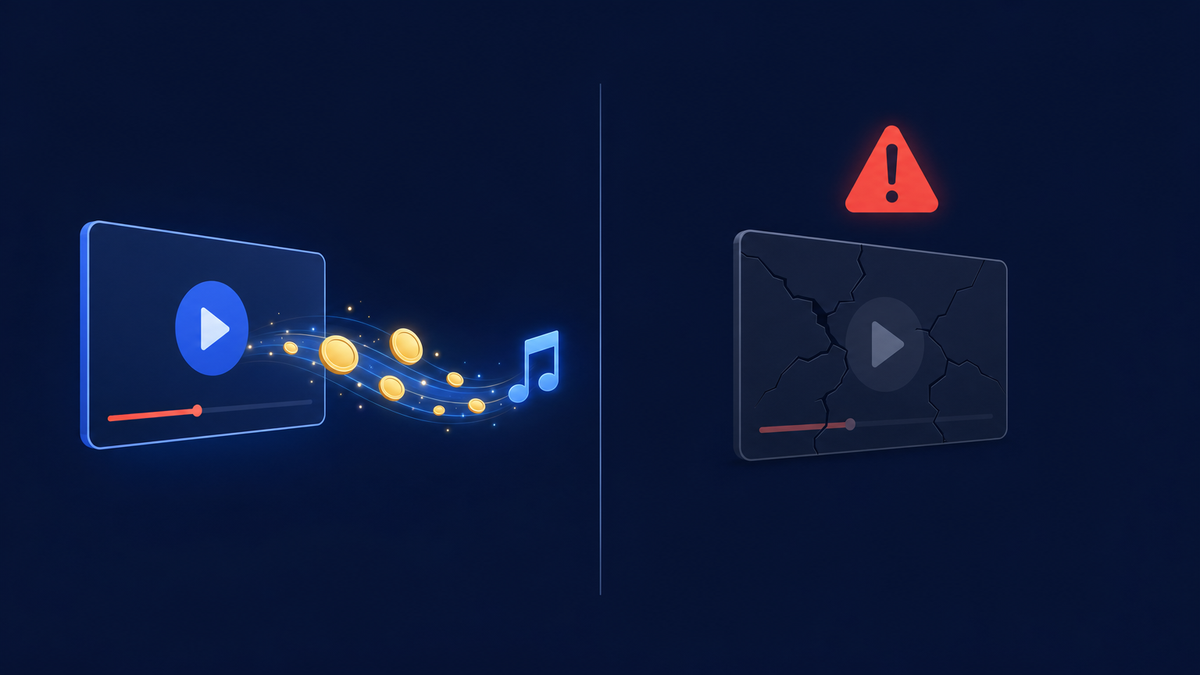
Content ID scans your upload against a database of reference files submitted by rights holders. If it matches, the claim is automatic and almost instant. YouTube says a claim can block the video, monetize it on the rights holder’s behalf, or just track its viewership, and that the outcome can differ country by country. For music, the usual outcome is the middle one: the video stays up and the ad money goes elsewhere.
The scale is the part most creators underestimate. YouTube’s own copyright transparency report, as summarised by TorrentFreak, puts the 2025 numbers in perspective:
- 2,502,941,368 Content ID claims processed in 2025, up 14% on the year before.
- 99.48% of all copyright actions on the platform were Content ID claims.
- Only 0.51% of those claims were disputed.
Nobody is slipping a chart record past this system. Plan for the claim before you upload.
What is the difference between a copyright claim and a copyright strike?
A claim is an automated match that affects one video. A strike is a legal removal request that affects your channel. YouTube states it plainly: “Copyright claims affect videos, but usually don’t impact your channel or account.” Getting a music claim is annoying and expensive, but it is not the emergency creators treat it as. Three strikes in 90 days is the emergency.
| Content ID claim | Copyright strike | |
|---|---|---|
| What triggers it | Automatic match against a rights holder’s reference file | A legal removal request from the copyright owner |
| What happens to the video | Usually stays up; revenue redirected to the rights holder, or the video is tracked or blocked in some countries | Removed from YouTube |
| Effect on the channel | Usually none | Counts against the channel; 3 in 90 days makes the account subject to termination |
| How it ends | Trim, replace, erase or mute the track, or dispute it | Expires in 90 days after Copyright School, if you have fewer than 3 |
Disputing a claim you have no real grounds for can escalate into a removal request. That is how a harmless claim turns into a strike. Dispute when you own the rights or hold a license, not as a reflex.
Does royalty free mean copyright free?
No, and this is the single most expensive misunderstanding in this topic. Royalty free describes the payment model, not the ownership. It means you pay once instead of paying per play. The track is still copyrighted, it is still in Content ID in many cases, and your right to use it comes entirely from the license you bought. Let the license lapse and the protection lapses with it.
YouTube says the same thing in its own guidance on finding music: “Even if you find music online that’s labeled ‘free,’ Content ID might still flag it.”
| Royalty free | Copyright free | |
|---|---|---|
| Who owns it | The composer or the library; still copyrighted | Nobody: public domain, or some Creative Commons tracks |
| What you pay | Once, or a subscription, instead of per play | Nothing, though Creative Commons usually requires a credit |
| Content ID | Often registered; whitelist your channel | Rarely registered, but a track labeled “free” can still be flagged |
| How common | Every subscription library | Rare; almost nothing on a subscription site |
Royalty free means you paid once. It does not mean nobody owns the track.
What music is genuinely safe to use?
Three sources are safe by design rather than by promise. The YouTube Audio Library is the baseline: YouTube says its tracks “won’t be claimed by a rights holder through the Content ID system,” and Partner Program members can monetize videos that use them.
- YouTube Audio Library. Free, inside YouTube Studio, and the only library YouTube itself calls copyright safe.
- Creator Music. Commercial tracks for US Partner Program channels, free to license or revenue share.
- Shorts audio library. Popular tracks inside the Shorts editor, reliable only under 60 seconds.
The Audio Library moved. The old youtube.com/audiolibrary address now redirects into YouTube Studio, where it sits under Audio library in the left menu. Two license types live there.
Standard Audio Library tracks need no credit. Creative Commons tracks do, and YouTube gives you a copy button that generates the attribution text for your description.
Paste the generated credit into your description every time. A missing credit is a license breach even when the track is free.
Not in the Partner Program yet?
Safe music protects what a video earns. Getting it watched is a separate problem, and the one most channels outside the Partner Program actually have.
That is exactly what Sprizzy is for: you pick the video and who should see it, and it runs the campaign on YouTube’s own ad platform, targeting by keywords, similar channels, location, age and gender. Real viewers only, no bots, from $50.
Can you actually license a popular song now?
Sometimes, which was not true when this post was first written. Creator Music is a catalog inside YouTube Studio that lets you use commercial tracks without losing monetization. It is open to US creators in the Partner Program, with expansion elsewhere still described as pending. Some tracks are free to license outright. Others put you in a revenue share with the rights holders.
The model changed this year. YouTube stopped selling paid Creator Music licenses on August 10, 2026. Licenses already applied to videos stay valid until they expire, and unused purchases were refunded. What is left is the free-to-license tier and the revenue-share tier.
Two limits are worth knowing before you build a video around a track:
- Revenue-share tracks cannot be used on Shorts or live streams.
- Brand channels and studios producing theatrical or streaming content are not eligible at all.
How does music work differently on Shorts?
Shorts have their own audio library stocked with tracks from labels that signed Shorts-specific deals, which is why you can put a current hit over a Short but not over a 12-minute video. Safety here is tied to duration. YouTube’s own warning is direct: “Music that’s safe to use in a Short that’s less than 60 seconds may not be safe to use in a longer video.”
Past the one-minute mark the rules harden. Shorts longer than one minute with an active Content ID claim are blocked on YouTube, whatever the claim policy says.
| Short under 60 seconds | Short over 60 seconds | |
|---|---|---|
| Shorts audio library track | Safe to use | May not be safe; YouTube gives no assurance |
| Active Content ID claim | The rights holder’s policy applies | Blocked on YouTube, whatever the policy says |
Monetization changes too. On a Short carrying one licensed track, half the revenue from its engaged views goes to the Creator Pool and half covers music licensing. Use two tracks and the Creator Pool share drops to a third.
We covered what an engaged view is separately.
Where should you get music if you are not in the Partner Program?
A subscription site, and the entry price has settled at roughly ten dollars a month across the main options if you pay annually. Read what you are buying, because the cheap tiers are personal-channel licenses. Client work, sponsored videos and paid ads almost always require the tier above, and that is where these services double or triple in price.
| Source | Cost (September 2026) | What to watch for |
|---|---|---|
| YouTube Audio Library | Free | The only library YouTube itself calls copyright safe. Creative Commons tracks need a credit in your description. |
| Creator Music | Free license or revenue share | US Partner Program channels only. No Shorts, no live streams on revenue-share tracks. |
| Shorts audio library | Free, inside the Shorts editor | Popular tracks, but only reliable under 60 seconds. A claim blocks a Short over a minute. |
| Bensound | Free with attribution, or paid licenses | The free license permits monetization, but each attribution text covers one video only. |
| Epidemic Sound (Creator) | $9.99/mo billed annually, $17.99 monthly | One personal channel per platform. Excludes client work, company marketing and digital advertising. |
| Artlist (Music & SFX Social) | $9.99/mo billed annually, $14.99 monthly | One personal channel per platform. Client projects need a Pro plan. |
| Soundstripe (Personal) | $119/yr, or $19.99/mo | Non-commercial only. Brand deals and sponsored posts require a higher tier. |
| Envato Elements (Core) | $16.50/mo billed annually, $39 monthly | Each download licenses one specific project, so a new video means a new download. Owned by Shutterstock since 2024. |
Register your channel with the library if it offers whitelisting. Most of these libraries have tracks in Content ID, and whitelisting stops your own paid-for music from claiming your own video. It is the most common avoidable claim there is.
How do you remove a claim you already have?
YouTube gives you four fixes in Studio without touching the rest of your video, plus the dispute route. Erase Song is the one that did not exist when this post was written. Added in July 2024, it uses an AI model to strip the claimed track while leaving dialogue and sound effects in place, which used to be impossible without a full re-edit.
- Erase song. Removes just the claimed track. YouTube warns the edit “might not work if the song is hard to remove.”
- Mute all sound. The blunt fallback. Kills everything in the claimed timestamps, including your voice.
- Trim out segment. Cuts the claimed section from the video entirely.
- Replace song. Swaps the claimed audio for a track from the Audio Library.
- Dispute. Only when you own the rights, hold a license, or have a genuine fair use case.
Any of the first four lifts the claim and returns monetization to you. None of them require a re-upload, so you keep the video’s URL, views and comments.
Deleting and re-uploading a claimed video to “start clean” throws away everything it has earned, and we listed it among the mistakes that keep small channels small.
Fix the claim in Studio. Never delete and re-upload.
How do you check a song before you publish?
Use the Checks step in the upload flow. YouTube runs a copyright scan before you publish, and “the Copyright check searches for copyrighted content in your video” while you finish the rest of the upload. If something matches, you can remove the claimed content or dispute it before anyone sees the video. Checks run in the background and you can publish while they are still running.
The old method no longer exists. YouTube retired the Music Policies directory along with Creator Studio Classic, and youtube.com/music_policies now returns a 404. You cannot look up a song’s policy without a video to test it against, so:
- Upload as private or unlisted. Nobody sees the video while YouTube scans it.
- Let Checks finish. The Copyright check runs in the background. Wait for it instead of publishing through it.
- Fix anything it finds. Remove or replace the claimed section, or dispute it if you hold a license.
- Publish once it is clean. A few minutes here saves the revenue on the video. We walk through the rest of that routine in what to do after uploading a video.
YouTube notes that copyright check results are not final, because a manual claim can arrive later. A clean check at upload is a good sign, not a guarantee.
What is not worth your time?
Five workarounds creators still reach for, all of which YouTube has publicly ruled out. They are collected on YouTube’s common copyright myths page, and every one of them fails for the same reason: none of them change who owns the recording. Content ID does not read your description, weigh your intentions or measure how much of the track you used. It matches audio, and then it applies whatever policy the rights holder set.
- Buying the song. “Just because you purchased content doesn’t mean you own the rights to upload or distribute it on YouTube.” A $1.29 download buys you a listening copy, not a sync license.
- Crediting the artist. Credit “doesn’t automatically give you the rights to use their copyrighted content.”
- Disclaimers. “No infringement intended,” “all rights go to the author” and “I do not own” carry no legal weight.
- Using only a few seconds. There is no safe-length rule. Any amount used without permission can trigger a claim.
- Pointing at other channels. Someone else’s video staying up tells you nothing about your rights, or about their license.
Fair use is real but it is not a setting you switch on. YouTube is explicit that automated systems cannot decide fair use “because it’s a subjective, case-by-case decision that only courts can make.”
Commentary and criticism have the strongest case. A montage set to a pop song has close to none.
Nothing you write in the description changes who owns the recording.
A claimed soundtrack is a leak worth plugging first, especially if you are still working toward the Partner Program thresholds.
Getting it watched is the other half. Test it with a small budget: Sprizzy campaigns start at $50, run on YouTube’s official ad platform with real viewers only, and your first one comes with a money-back guarantee.
If the song is yours, how to promote a music video on YouTube has the release plan, from the Official Artist Channel to the first ad campaign.
Common questions
Can I use copyrighted music on YouTube if I give credit to the artist?
No. YouTube states that giving credit "doesn't automatically give you the rights to use their copyrighted content." Credit is a courtesy, not a license. The same applies to disclaimers like "no infringement intended" or "all rights go to the author," which YouTube lists among its common copyright myths. Content ID never reads your description before it matches the audio.
What actually happens if I use a copyrighted song anyway?
Content ID matches the audio and applies whatever policy the rights holder chose. Usually the video stays online and the ad revenue goes to them instead of you. It can also be tracked or blocked in certain countries. YouTube says claims "usually don't impact your channel or account," so a music claim is a revenue problem rather than a strike.
Is royalty free music the same as copyright free music?
No. Royalty free describes the payment model: you pay once instead of per play. The recording is still copyrighted and often still registered in Content ID. Your right to use it comes from the license you bought, so canceling a subscription can end your coverage. YouTube warns that music labeled free online can still be flagged.
Can I use popular songs in YouTube Shorts?
Yes, through the Shorts audio library built into the Shorts editor, which is stocked with tracks from labels that signed Shorts-specific deals. The catch is length. YouTube warns that music safe in a Short under 60 seconds may not be safe in a longer video, and Shorts over one minute with an active claim are blocked outright.
Does buying a song on iTunes or Amazon let me use it in my video?
No. YouTube puts it directly: "Just because you purchased content doesn't mean you own the rights to upload or distribute it on YouTube." A purchase buys a listening copy. Putting a recording under video requires a synchronization license from the rights holders, which is a separate agreement and rarely available to individual creators.
Where is the YouTube Audio Library now?
Inside YouTube Studio, under Audio library in the left menu. The old youtube.com/audiolibrary address redirects there. Tracks carry one of two licenses: the standard Audio Library license, which needs no credit, or a Creative Commons license, which requires you to credit the artist in your description using the text YouTube generates for you.
Can I check whether a song is safe before I publish?
Only against a specific upload. The Music Policies directory that used to let you look up a song was retired with Creator Studio Classic and now returns a 404. The replacement is the Copyright check in the upload Checks step, so upload as private or unlisted, let the check finish, then publish once it comes back clean.
Is using ten seconds of a song fair use?
There is no safe-length rule. YouTube says any amount of copyright-protected content used without permission can cause copyright issues, and that automated systems cannot decide fair use "because it's a subjective, case-by-case decision that only courts can make." Commentary and criticism have the strongest case. A montage set to a pop song has close to none.