
Here is exactly what changed, who it affects, and what to do about it before the deadline.
What are the new YouTube monetization requirements for 2027?
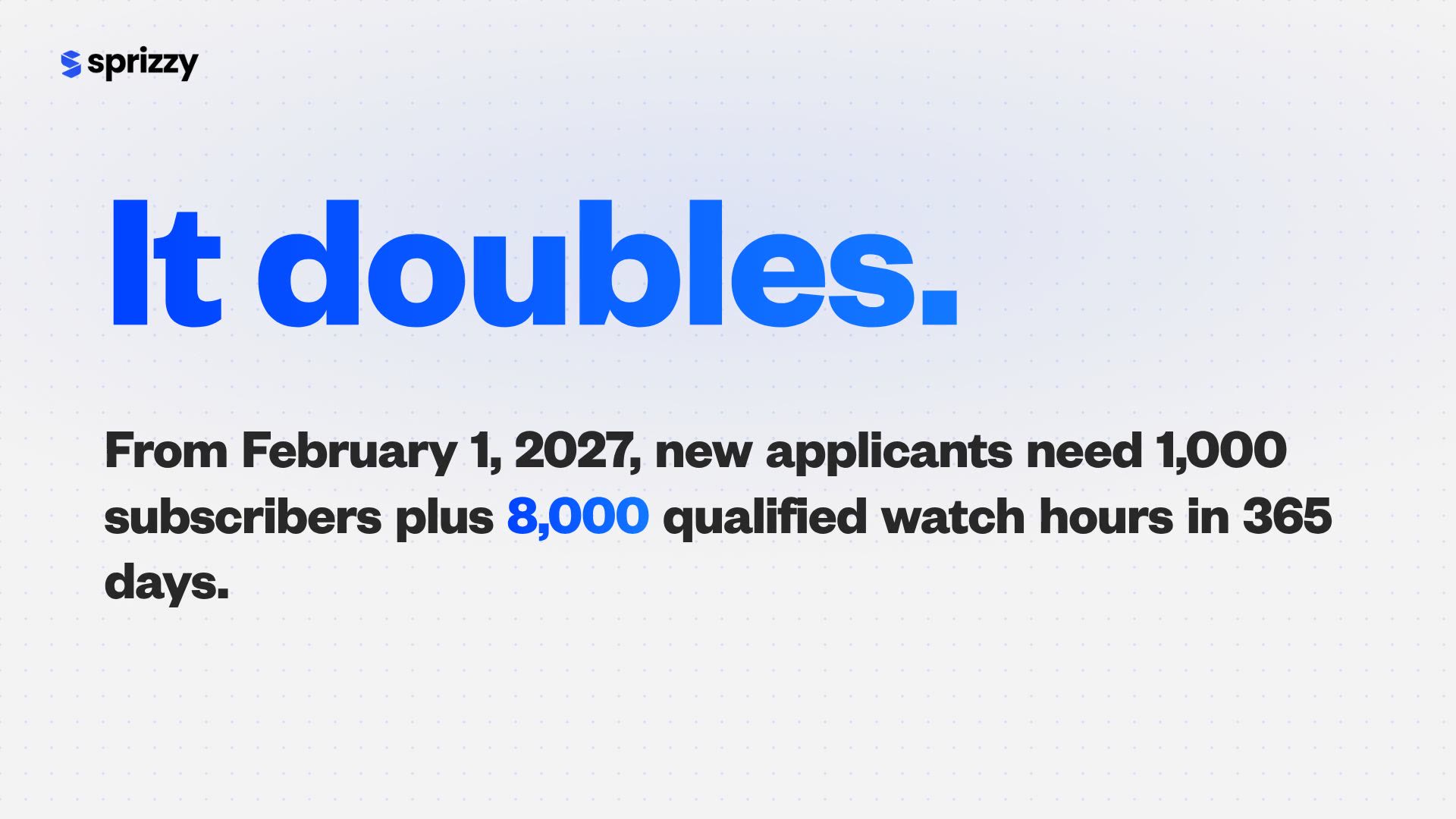
From February 1, 2027, joining the YouTube Partner Program’s full ad-revenue tier requires 1,000 subscribers plus either 8,000 qualified watch hours in the last 365 days or 20 million qualified Shorts views in the last 90 days. Both media thresholds doubled from 4,000 hours and 10 million Shorts views. If you already meet today’s requirements, applying before February 1 means you’re reviewed under the current, lower bar.
| Requirement | Until Jan 31, 2027 | From Feb 1, 2027 |
|---|---|---|
| Subscribers | 1,000 | 1,000 (unchanged) |
| Watch hours (last 365 days) | 4,000 | 8,000 |
| OR Shorts views (last 90 days) | 10 million | 20 million |
Why YouTube did it: the platform now sees over 200 billion Shorts views daily and more than a billion hours of daily TV watch time, per TechCrunch’s coverage of the announcement.
The subscriber bar stays at 1,000. Only the watch-hour and Shorts-view thresholds double.
Does the 8,000-hour rule affect channels already monetized?
No. Channels already in the Partner Program are grandfathered in and keep their monetization under the old thresholds. Long-form ad revenue for existing members is not affected. There is one catch: from the same date, channels must keep 10 million qualified Shorts views in the last 90 days to keep earning from Shorts ad and subscription revenue sharing.
Already in the program? Your long-form ad revenue does not change.

Should you rush to apply before February 1, 2027?
Yes, if you’re close. A channel with 1,000 subscribers and 4,000 watch hours today qualifies; the same channel on February 1 would need twice the watch time. If you’re within reach of 4,000 hours, the next few months are the cheapest path to monetization you will ever get.
- Check your numbers. Open the Earn tab in YouTube Studio and compare your subscribers and qualified watch hours with the bars above. Our plan for getting 4,000 watch hours before February 2027 has the daily math.
- Apply the day you qualify. Review times vary, so do not wait for a buffer.
- Close the gap with viewers who stay. If you’re short, put your best video in front of people who would choose to watch it. Sprizzy does that through YouTube’s official ad platform, targeting by keywords, similar channels, location, age and gender, from $50. The organic watching those viewers do afterwards builds the hours.
Every hour you add before February 1 is worth two after it.
How does paid promotion help you reach 8,000 hours?
Ads find the audience and the video keeps them. YouTube counts only “qualified” watch hours toward Partner Program thresholds, and time watched while your video runs as an ad is excluded. Paid promotion puts your video in front of viewers who then subscribe, return and watch organically, and that watch time counts. Sprizzy has done this for over 1.5 million channels since 2016; here is how a campaign works.
Promote the video with your best retention, not your newest one. The viewer who finishes it comes back for the next upload.
One related change: since August 24, 2026, YouTube counts a public view from the first frame of playback, while monetization still uses the stricter engaged-view definition. Our explainer on YouTube views vs engaged views covers where to find the number that still matters.
How do you realistically build 8,000 watch hours in a year?
8,000 hours over 365 days averages about 22 hours of watch time per day. For a channel with 10-minute videos and 40% average retention, that’s roughly 330 views per day across your library. Four levers move that number.
- Longer videos, honestly done: a 20-minute video at the same retention rate earns double the hours per view.
- Evergreen beats topical: a how-to that draws search traffic for a year quietly out-earns a spike that dies in a week.
- Sessions over singles: playlists and end screens turn one view into forty minutes.
- Recruit real viewers: subscribers gained now multiply every future upload’s watch time. Sprizzy campaigns start at $50 and your first one comes with a money-back guarantee.
Watch hours compound: more subscribers means every upload starts with more watch time.
What does this mean for Shorts-first creators?
The Shorts path doubled to 20 million qualified views in 90 days for new applicants, a very high bar. Under that level, the practical route is hybrid: use Shorts for discovery, then convert those viewers to long-form watch time that counts toward the 8,000 hours.
Already earning from Shorts? From February 1, 2027 you need 10 million qualified Shorts views in the last 90 days to keep that revenue share.
Common questions
When do the new YouTube monetization requirements take effect?
February 1, 2027. YouTube announced the change on August 10, 2026. Channels that apply and qualify before that date are reviewed under the current 4,000-watch-hour / 10-million-Shorts-view thresholds, and existing Partner Program members keep their monetization.
Is the 1,000 subscriber requirement changing too?
No. The subscriber requirement for the full Partner Program stays at 1,000. Only the media thresholds double: 8,000 qualified watch hours in the last 365 days, or 20 million qualified Shorts views in the last 90 days.
Do paid ad views count toward the watch-hour requirement?
No. Watch time earned while your video runs as a paid ad is excluded from Partner Program thresholds. Promotion helps indirectly: it brings in subscribers and returning viewers whose later organic watch time does count.
Will already-monetized channels lose monetization under the new rule?
No for long-form ad revenue: existing members are grandfathered in. The exception is Shorts revenue sharing: from February 1, 2027, channels need 10 million qualified Shorts views in the last 90 days to keep earning from Shorts specifically.
What is the fastest way to reach 8,000 watch hours?
Compound a library of evergreen, high-retention videos: consistent uploads, longer flagship videos, playlists and end screens that chain sessions, and growing your subscriber base so every upload starts with more organic watch time. 8,000 hours in a year averages about 22 watch-hours per day.