Search any promotion service’s name and the next suggestion is usually “legit” or “scam”. That is a fair question, and you can answer it yourself, without taking the company’s word for anything. Seven checks, each with a place to look, decide it before you pay.
What separates a legitimate YouTube promotion service from a view seller?
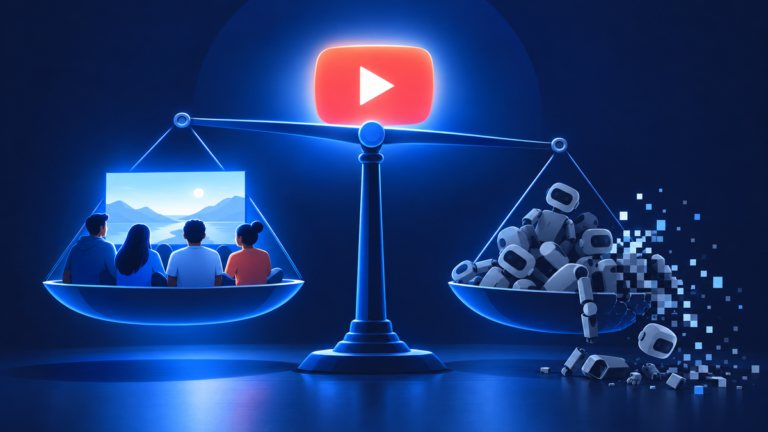
One thing: a legitimate service buys ads for your video on YouTube’s own ad platform, so real people see the ad and choose to watch. A view seller delivers a count. YouTube’s policy bans “anything that artificially increases the number of views, likes, comments, or other metrics”, and “page traffic found to be artificial will not be counted on YouTube and can lead to strikes on your account” (YouTube Help).
| What you are buying | Ad-based promotion | A view seller |
|---|---|---|
| What the money buys | Ad impressions on YouTube; a view is counted only when someone watches or clicks | A fixed number of views, likes or subscribers |
| Who watches | People YouTube showed the ad to, who chose to keep watching | Bots, hijacked accounts or paid clickers |
| What YouTube does with it | Counts it; its own ad help page states that views and subscribers gained this way “are legitimate” | Audits it out; artificial traffic “will not be counted” |
| Where you can verify it | Your own YouTube Studio, under one named traffic source | Nowhere; the count is the product |
The law has caught up too. Since October 2024 a US trade rule “prohibits anyone from selling or buying fake indicators of social media influence, such as followers or views” (Federal Trade Commission, 16 CFR Part 465).
The rule reaches a buyer who knew or should have known the numbers were fake; here is what the law and YouTube’s terms say. Buying ads carries none of it: ads do not touch your organic performance.
A real promotion is an ad. Everything a view seller offers is a number.
Check 1: Do the views show in your own YouTube Studio?
They should, under a traffic source named for exactly this. The YouTube Analytics help page states: “If your video is used as an ad on YouTube, you’ll see ‘YouTube advertising’ as a traffic source” (YouTube Help). That row is the receipt. A service whose views never appear there, or appear under “Direct or unknown”, is not buying ads for you.
- Open the video in YouTube Studio. Go to Analytics, then the Reach tab, and find the “How viewers find this video” card.
- Look for the “YouTube advertising” row. During a real promotion it climbs day by day and sits beside your organic rows, never replacing them.
- Give it 72 hours. Ad platforms and Analytics count on different clocks, so the first day’s numbers rarely match; here is why the two reports differ.
- Watch what happens after. YouTube’s counting page states it may “discard low-quality playbacks” and “slow down, freeze, or change your metric count” while it confirms views (YouTube Help). A bought count shrinks. Ad views stay, because the same page counts “paid advertising views” as views that show “a viewer interacted with the video”.
Why this check is yours to run. The fake-engagement policy adds: “If you hire someone to promote your channel, their decisions may impact your channel.” Your channel carries the risk, so you read the row.
This is the row Sprizzy promotions land in, because every Sprizzy view is a YouTube ad, counted by YouTube itself.

Check 2: Is it a real ad, and can you see it before you pay?
A legitimate service can tell you which ad format it buys and show you the ad. YouTube ads come in three forms for a creator’s video: in-feed, skippable in-stream, and Shorts. Each has its own rule for when a view is counted, set by Google, not by the service (Google Ads Help). If the company cannot name the format, it is not placing ads.
| Ad format | Where it shows | When a view counts |
|---|---|---|
| In-feed | Search results, the home feed, next to related videos | The viewer clicks the thumbnail, or the video autoplays inline for at least 10 seconds |
| Skippable in-stream | Before, during or after other videos, skippable after 5 seconds | 30 seconds watched, or to the end if shorter, or a click on the ad |
| Shorts | In the Shorts feed, skippable any time | 10 seconds watched, or to the end if shorter |
What the rule means for you. A skippable in-stream view does not exist until 30 seconds. Someone who skips at five seconds costs nothing and counts nothing. An ad view is a person who chose to watch, and Analytics counts it at the same line.
Ask to see the ad before you pay. Sprizzy shows your video as it will look in the feed and in Shorts on its ad preview page, before sign-up, and a person checks every promotion before it runs.
Check 3: Does it report where the ad ran and who watched?
Google’s own guide for advertisers who hire a third party puts it plainly: “At a minimum, you have the right to know the number of clicks, impressions, and the total cost of your Google ads” (Google Ads Help). A real service reports where the ad was placed, which countries watched, and what was spent. A service that reports only a view total is hiding the one thing that proves the views were ads.
The same guide lists the warning signs. Withholding click, impression or cost data. Guaranteeing a position. Claiming to be from Google. Spending a budget other than the one you agreed. Suggesting that ads change your organic ranking.
- Placements. The channels and videos your ad appeared on or next to.
- Countries. Where the viewers were, so you can match it to your targeting.
- Spend. How the budget was used, so a $50 promotion accounts for $50.
If a company will not show you where the ad ran, assume it never ran.
Check 4: Is the price a budget you set, or a package of views?
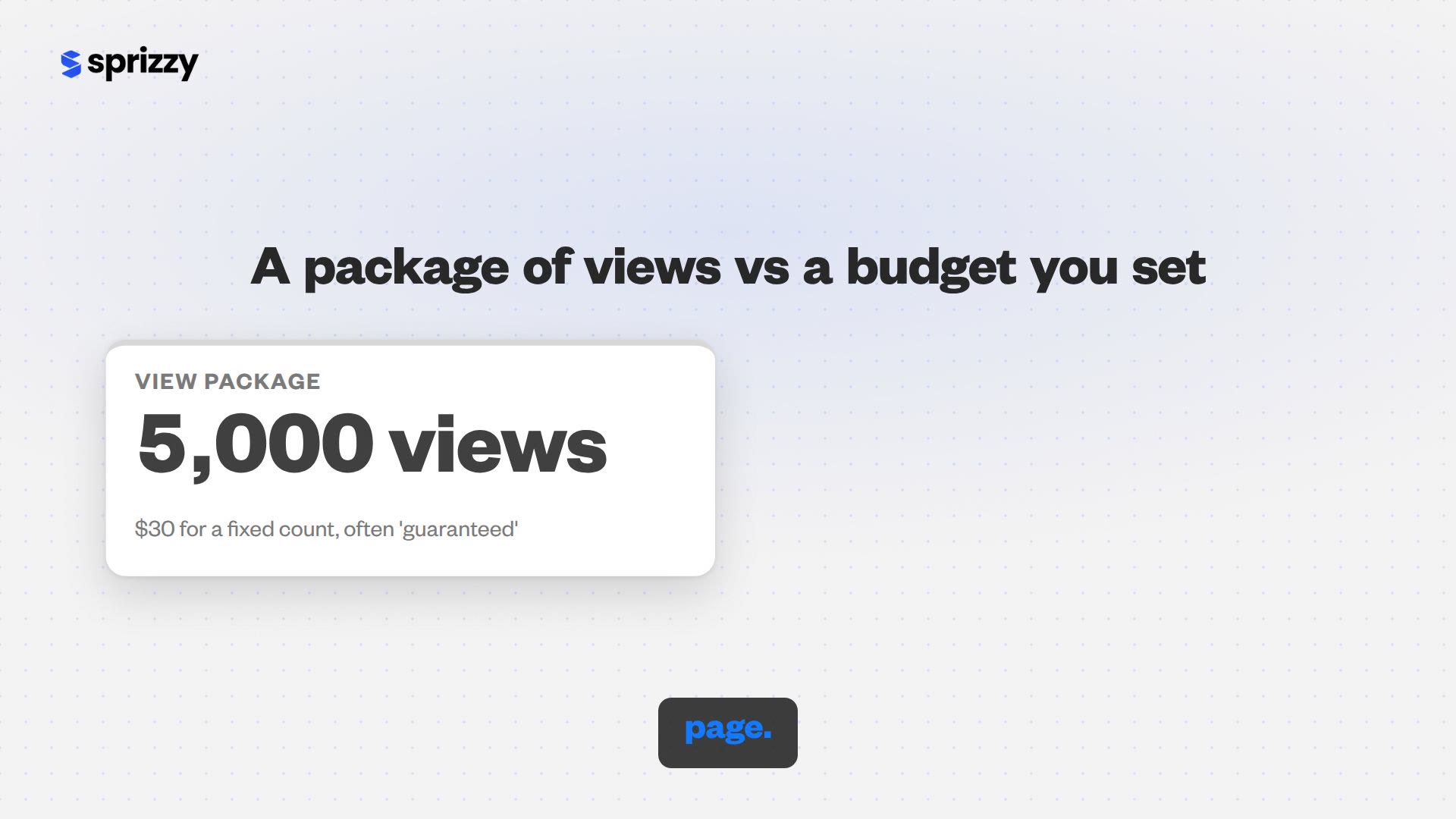
A budget is how ads are bought; a package is how counts are sold. On YouTube’s ad platform you pay for each view as it happens, and nobody can promise how many views a budget will produce, because the audience decides. So “5,000 views for $30” is a promise about a count, and a promised count is the fake indicator the FTC rule covers. Package pricing is the clearest tell on any sales page.
- Budget pricing: you choose the amount, the service reports what it bought, and unused money comes back or rolls into the next promotion.
- Package pricing: a fixed count for a fixed price, often with “guaranteed” or “delivery in 24 hours” beside it.
- Gig marketplaces: the same test works on a $5 listing. Here is how to tell whether a Fiverr YouTube promotion gig is real or bots.
- Estimates are fine. An estimate labelled as one is honest. A guarantee of a number is the problem. Here is what a $50 budget actually buys.
Sprizzy promotions start at $50, you set the budget, there are no monthly fees, and you pay only when a real viewer watches your ad. Unused funds can be refunded or moved to a new promotion.
Check 5: What does it ask you for?
A legitimate service needs your video link and, at most, a read-only connection to your channel through Google sign-in so it can show your results. It never needs your YouTube password. The sales pitch runs the other way too: a real company asks you to pay for ads, while the scams that borrow promotion companies’ names pay you small sums to watch and subscribe, then ask for deposits.
- Never your password or a login to your Google account.
- Never payment in cryptocurrency, gift cards or wire transfer. Card, PayPal and the usual wallets, through a named processor, are what to expect.
- Never a message on Telegram or WhatsApp offering paid “tasks”, a “membership number” or a “mentor”. That pattern is a job scam using a promotion company’s name; Sprizzy documents the exact script because it has been impersonated this way.
- Never a request to watch or subscribe to other channels in exchange for views on yours. That is the subscriber swap YouTube’s policy names.
You pay a promotion service. Anyone who offers to pay you is running a different business.
Check 6: Who is the company, and how do refunds work?
Look for a legal entity, a street address, a founding year and a guarantee with conditions written down. A guarantee with an eligibility list is real, because it tells you when it pays. A guarantee with no conditions is a slogan. Then check what happens to unused money: on a budget model the unspent part is refundable, and the terms should say how long a refund takes.
- Read the footer and the terms. The legal name and the address should match on both, and the terms should name who you are contracting with.
- Count the years. A company that has run ads for creators for a decade has a track record you can search; a brand registered this year does not.
- Read the guarantee page in full. Who qualifies, what triggers a refund, how much, in what window, and what is excluded. Sprizzy’s version is public: Sprizzy Media LLC, Mount Laurel, New Jersey, promoting videos since 2016, and a money-back guarantee on your first promotion that refunds what you paid, up to $100, if it ends below the estimate.
- Find the support channel. Live chat on the site, a support email and a help center are the normal set. Nothing but a contact form is a thin company.
Refund terms that cover only “undelivered views” are package terms in disguise. A budget service refunds unused budget, and the guarantee covers the result.
Check 7: Do the reviews link to where they were posted?
A review you can click through to its source, with a date and the reviewer’s name as posted, is evidence. A wall of first names and five stars on the company’s own page is copy. The same US rule that bans buying fake views also bans fake testimonials, including reviews from people who do not exist and undisclosed insider reviews, so an honest company has every reason to link its reviews.
- Click through. The review should exist on the third-party site, with the same wording.
- Read the one-star reviews first. They tell you what goes wrong and whether the company answers.
- Look for the mechanism in the words. Reviewers who mention seeing the views in their own Analytics, or the traffic source by name, are describing an ad campaign. Reviewers who mention a count arriving overnight are describing a view seller.
- Treat “top services” lists as ads. Many are paid placements or affiliate pages; a list that ranks a service it has never used is telling you about its commissions.
A review is evidence when you can leave the company’s site and still find it.
How does Sprizzy hold up against the seven checks?
Here is each check answered with a place to look, none of them our word. Sprizzy promotes your video as a YouTube ad through Google Ads, which is why every number below is one YouTube or a payment processor reports, not one we type. Over 1.5 million channels have partnered with Sprizzy since 2016, and the first promotion is covered by the money-back guarantee.
| Check | Where to look | What you will see |
|---|---|---|
| 1. Views in your Studio | YouTube Studio, Analytics, Reach | Your promotion’s views in the “YouTube advertising” row, beside your organic rows |
| 2. A real ad you can see | The ad preview page | Your video in the feed and in Shorts, as the ad will run, before sign-up |
| 3. Where the ad ran | Your Sprizzy report | Who watched, by country and by placement, plus views and watch time |
| 4. A budget, not a package | The pricing page | From $50, one-time, you pay per view, no monthly fees |
| 5. What it asks for | The checkout and sign-in | Google sign-in for your channel; card, PayPal, Apple Pay, Google Pay or Venmo through Braintree |
| 6. Who you are paying | The footer and terms | Sprizzy Media LLC, 717 Fellowship Rd, Mount Laurel, NJ; support@sprizzy.com; since 2016 |
| 7. Reviews with sources | Is Sprizzy legit? | Reviews quoted verbatim, each linked and dated, and the same seven checks run on us |
What that means for your next video. Pick the video, enter keywords and similar channels, set location, age and gender. Sprizzy tests more than 200 combinations of keywords, channels and demographics, then moves your budget to the ones that earn subscribers at the lowest cost.
Most creators pay less for each subscriber than when they run the ads themselves. Setup takes about three minutes; start with $50.
Choosing between services, not just checking one? Here is what to look for in the best YouTube promotion service, from the Google Partner badge to the money-back guarantee. Or see what Reddit says to check in a YouTube promotion service.
Run the seven checks on anyone, including us. The answers are in your own Studio.
Common questions
What happens if I buy YouTube views?
YouTube's fake-engagement policy states that page traffic found to be artificial will not be counted and can lead to strikes, and that channels which keep violating it may be terminated. In practice the count climbs, YouTube audits it, and the number falls back while the channel carries the risk. Views from a real ad campaign stay, because YouTube counts them as views where a viewer chose to watch.
Can you get banned for buying YouTube subscribers?
Yes. Subscribers from bots or bought accounts fall under the same policy as bought views: YouTube removes subscribers identified as spam from your count, strikes can follow, and three strikes within 90 days end the channel. Subscribers gained from an ad campaign are different: YouTube's own help for its ad product states that views and subscribers gained through promotions are legitimate.
Can YouTube detect fake views?
YouTube's counting page states that its systems take time to decide which views, likes and subscriptions are legitimate, that it may slow down, freeze or change a metric count while confirming, and that it discards low-quality playbacks. It does not publish the signals it uses, which is the point: a seller cannot know what will survive the audit, and the channel owner finds out when the number drops.
How do I know if a promotion service uses bots?
Run the Studio check. Real ad views appear in YouTube Analytics under the Reach tab in the “YouTube advertising” traffic source, next to your organic rows, and they stay after YouTube's audit. Bought views arrive as a sudden spike under Direct, External or unknown sources, carry almost no watch time, and shrink later. A service that cannot name its ad format or show you where the ad ran is not buying ads.
Is it safe to pay to promote a YouTube video?
Paying for ads is safe: YouTube's own help for its ad product states that promotions do not impact a channel's or a video's organic performance and that the views and subscribers gained are legitimate. Sprizzy promotes your video the same way, as a YouTube ad through Google Ads, from $50, with the views counted by YouTube in your own Studio and a money-back guarantee on your first promotion.
Does a legitimate promotion service need my YouTube password?
No. A real service needs your video link and, at most, a read-only connection to your channel through Google sign-in so it can show your results. Never share your password, never pay in cryptocurrency or gift cards, and never accept an offer to be paid for watching or subscribing: that last one is a job scam that borrows promotion companies' names on Telegram and WhatsApp.
Do promoted views show up in YouTube Analytics?
Yes, under the “YouTube advertising” traffic source, with one timing rule: a skippable ad view is counted when the viewer watches 30 seconds or to the end, and non-skippable ads never count as views in Analytics. The ad platform and Analytics count on different clocks, so allow up to 72 hours before comparing the two reports; the totals converge, they do not match on day one.