
This guide replaces two older Sprizzy posts that split the same list across two parts. Everything here has been re-checked against YouTube’s current documentation, and the mistakes that turned out to rest on folklore rather than evidence have been rewritten or removed.
1. Do your videos make one clear promise?
Experimenting across your first dozen videos is fine and often necessary. The problem starts when a viewer lands on your channel and cannot work out what they would be subscribing to. People open YouTube to learn something or to be entertained by someone specific. Each video should promise one of those two things in its title and deliver it in the first minute.
A niche is not a prison. You can cover several topics as long as the promise stays recognizable: the same kind of help, the same voice, the same reason to come back. Random uploads with no through-line give the algorithm nothing to match and give the viewer no reason to hit subscribe.
2. How much does the first 30 seconds really matter?
More than most creators think, and YouTube publishes the number for you. The audience retention report includes an Intro metric showing the percentage of viewers who keep watching past the first 30 seconds. When that figure is low, YouTube’s own advice is to change the thumbnail and title so they match the video, or to rework those opening 30 seconds and try a different style.
The fix is rarely subtle. Cut the branded intro animation, cut the apology for not uploading, and open on the most interesting thing you have. Tease a clip from the best moment, ask the question the viewer came to have answered, or state the surprising part up front and explain it after.
This matters more since August 2026, when YouTube changed how views are counted so that a view registers from the first frame. The metric that now separates a curious click from a real viewer is engaged views, which is explained in our guide to views versus engaged views.
3. Does uploading inconsistently hurt your channel?
Not in the way people usually claim. YouTube’s documentation does not describe a penalty for gaps between uploads, and its recommendation system guidance states that the algorithm uses fresh performance data for each individual video rather than relying on past results. One quiet month does not put a mark against your channel.
Consistency still matters, for human reasons. Your audience learns when to expect you, and you learn faster from a steady cadence than from a burst of ten videos followed by silence. A visitor who sees your last upload was fourteen months ago assumes the channel is finished and does not subscribe.
YouTube’s upload schedule tips frame this as sustainability rather than volume: pick a frequency you can hold for a year. If batching is what makes weekly possible, batch and schedule.
4. Do you know how YouTube actually decides what to recommend?
Many small creators call the outcome luck because they never learned the mechanics. Two facts do most of the work. Each video is assessed on its own performance rather than your channel’s history, and tags barely register: YouTube states that tags play a minimal role in discovery unless your topic is commonly misspelled. Title, thumbnail and description carry the weight.
The signals that do count are viewer behavior: whether people click, how much of the video they watch, and what they do afterwards through likes, shares, comments, survey responses and “not interested” feedback. Optimize for those and the rest follows.
For ongoing learning, YouTube’s own Creator Insider channel and the Help Center pages linked throughout this article are the primary sources. Among independent educators, Think Media, Roberto Blake, Derral Eves, Gillian Perkins and Sunny Lenarduzzi all publish current material. Watch the newest videos on any channel you follow, because advice from 2019 is often wrong now.
5. How long should you give a new channel before judging it?
Give it a year of genuine effort, and judge it against YouTube’s published milestones rather than an invented subscriber target. There is no official benchmark for what a first-year channel should reach, so any specific number you have been quoted is a guess. Below the first tier there is no official milestone at all, which is why our guide to getting your first 100 subscribers is about learning to make the video rather than chasing a badge. The monetization tiers are fixed, public and worth aiming at.
| Milestone | What it takes | What it unlocks |
|---|---|---|
| Expanded partner tier | 500 subscribers, 3 public uploads in 90 days, plus 3,000 watch hours in 12 months or 3 million Shorts views in 90 days | Fan funding: memberships, Super Thanks, Super Chat, Shopping |
| Full partner program, today | 1,000 subscribers plus 4,000 watch hours in 12 months or 10 million Shorts views in 90 days | Share of ad revenue |
| Full partner program, from 1 February 2027 | 1,000 subscribers plus 8,000 watch hours in 12 months or 20 million Shorts views in 90 days | Share of ad revenue |
Sources: YouTube’s expanded tier and partner program pages, plus the 2027 threshold change. Existing partners are not affected by the new numbers. We covered what the change means for small channels in our explainer on the 8,000 watch hour rule.
6. Should you copy the titles big channels use?
Those titles work because the audience already exists. A shouty all-caps vlog title earns millions of views when millions of people already care about the person in the thumbnail. On a channel nobody knows yet, the same title promises something the video cannot deliver, and that is close to how YouTube defines malicious clickbait in its spam and deceptive practices policy.
The consequences are real: removal with a warning or strike, suspended monetization, or termination after three strikes in 90 days. Copy the discipline of big channels instead of their packaging. Their early videos were specific, searchable and useful, which is exactly what a small channel needs.
7. Is your audio and lighting costing you viewers?
Probably, and audio costs more than picture. Viewers forgive a soft image and leave over hiss, echo and background noise. Before buying anything, record 30 seconds in the room you film in and listen on headphones. A fan, an air conditioner or a hard-walled kitchen will be obvious. Fix the room first, then the microphone.
A phone held close records usable sound. Most mirrorless and DSLR cameras do not, so they need help: a lavalier clipped to your shirt for talking to camera, or a shotgun mic aimed at your mouth for anything else. Both pick up sound from one direction and reject most of the room.
Lighting is cheaper to solve. Face the largest window in your home and film during the day. When that is not possible, one panel or ring light with a dimmer, positioned slightly off to the side and above eye level, removes the harsh overhead shadows. For specs, 1080p is a sensible floor, and YouTube asks that you upload in the same frame rate you recorded in, so pick one and stay with it.

8. Are your titles and thumbnails doing their job?
Ask what a stranger would type to find your video, then put that in the first half of the title. A cooking channel that titles a video “Cook with Carmen Episode 5” is invisible to everyone who has not heard of Carmen. “Peanut Butter Chocolate Kiss Cookies, my favorite recipe” finds the people searching for that cookie and still sounds like a person.
Thumbnails deserve the same planning. Shoot a frame for the thumbnail before you pack up, while the lighting and the outfit still match the video. Uploading a custom thumbnail requires a verified account and a 16:9 image, and it is worth doing on every video.
You no longer have to guess which version wins. YouTube’s Test & Compare tool runs up to three titles, three thumbnails, or three combinations against each other, picks the variant with the highest watch time, and finishes within about two weeks. It needs advanced features enabled and desktop Studio, and it does not work on Shorts, Premieres or content made for kids. If search traffic is the gap you are trying to close, our guide to how YouTube decides which videos rank in search covers the signals behind it.
9. Do you have to reply to every comment?
Reply to as many as you can while the number is still small, because that is the only period when it is possible. Comments are one of the engagement signals YouTube names in its recommendation guidance, and a reply is the cheapest way a small channel converts a one-time viewer into a regular. Hearting a comment takes a second and is noticed.
One old piece of advice needs correcting: a dislike is not a free engagement point. YouTube’s own explanation of private dislike counts says viewers dislike a video to tune their recommendations and to send private feedback to the creator. That is negative feedback which also teaches that viewer’s feed to show less of your work. Creators still see exact dislike counts in Studio.
Pinning your own comment with a question is a good habit and needs advanced features enabled on the channel.
10. Are you waiting for YouTube to promote the video for you?
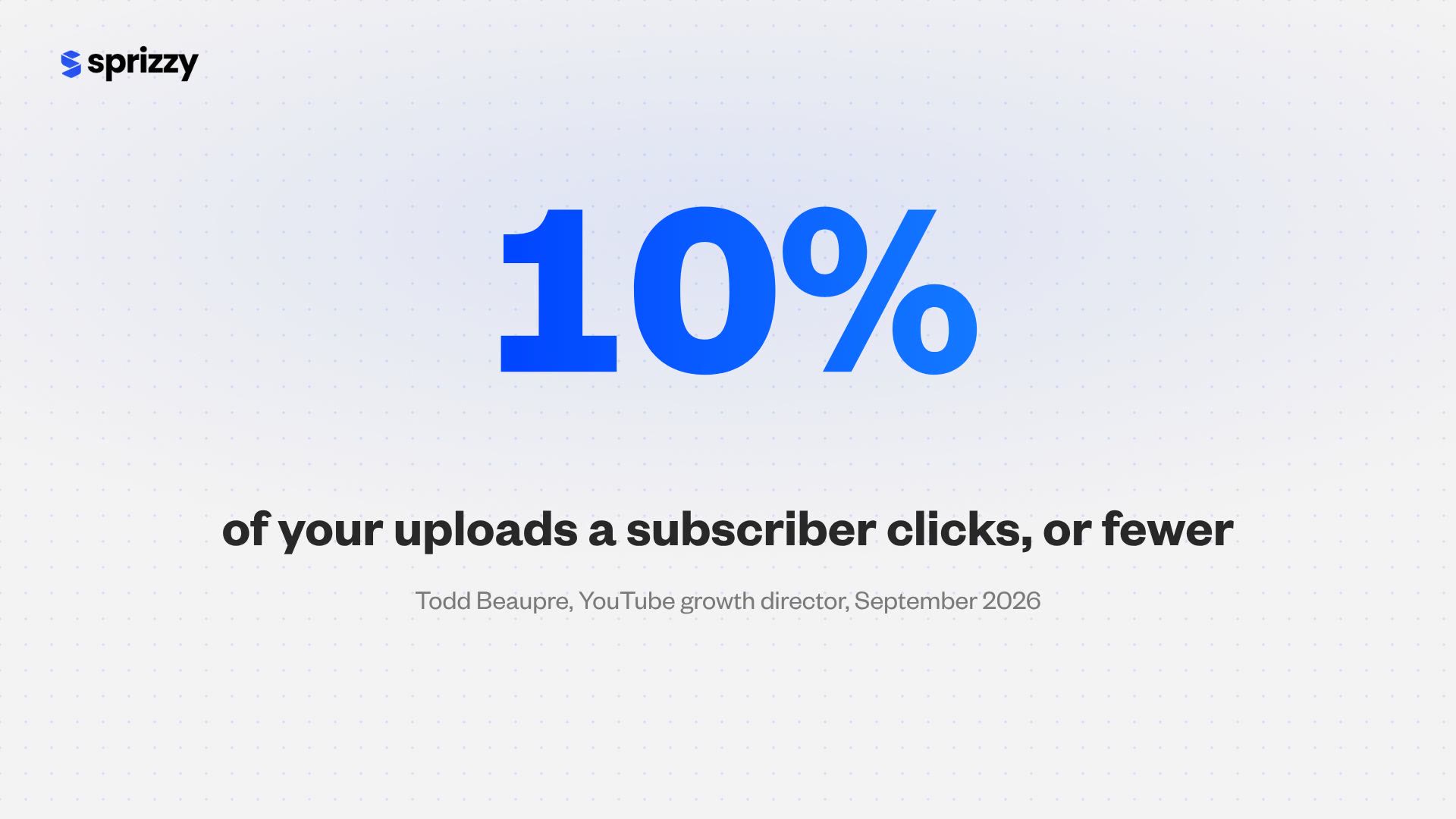
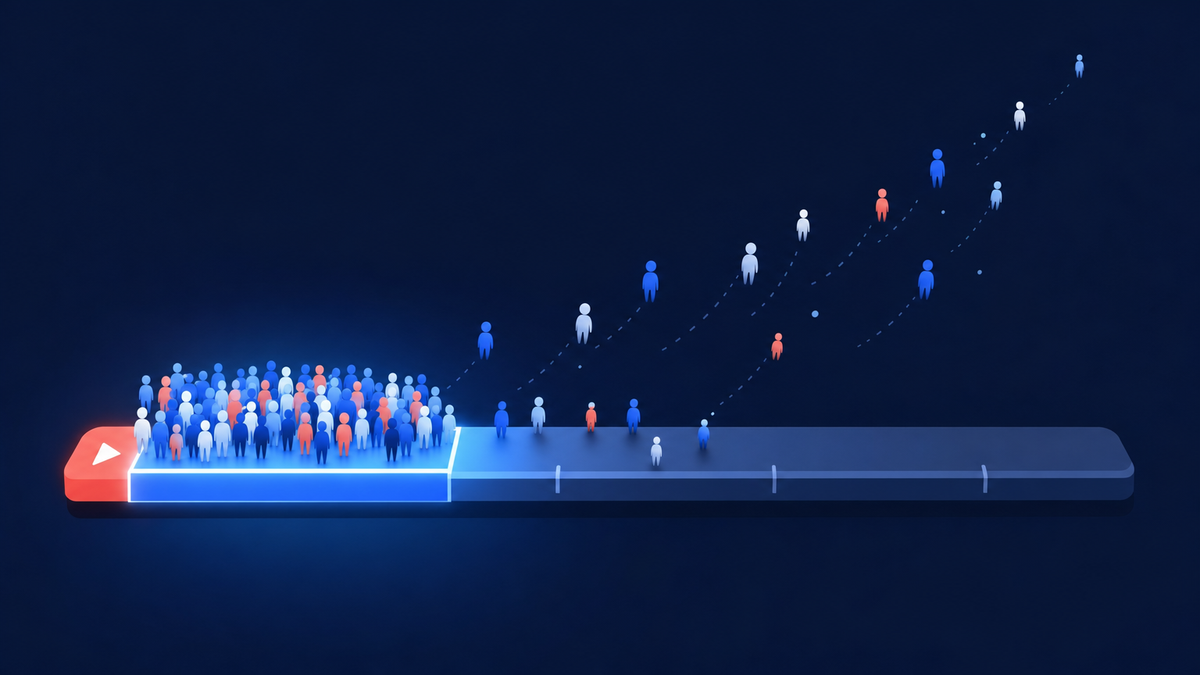
Publishing is not distribution. Todd Beaupré, YouTube’s senior director of growth and discovery, said on Creator Insider in September 2026 that a channel’s own subscribers typically click through on about 10% or fewer of its uploads. Even people who chose to follow you skip most of what you publish.
Notifications will not rescue that. Only subscribers who set the bell to All are eligible, and a channel can send a maximum of three video notifications in any 24 hours. So do the legwork: cut a native vertical clip for each platform you use, answer questions in communities where your topic already comes up, and link the video from anywhere you already have an audience. Our guide to what to do after uploading covers the first 48 hours in order.
Paid promotion is the other lever, and it does not carry the risk creators fear, as we set out in do YouTube ads hurt your channel. You can test paid promotion with a small budget: Sprizzy campaigns start at $50 and come with a money-back guarantee on your first campaign. One caveat worth knowing before you start: watch time from ad campaigns does not count toward the partner program watch-hour threshold.
Which newer YouTube features are small channels not using?
Three surfaces did not exist when most “grow your channel” advice was written. Shorts now run up to three minutes, have their own feed, and from February 2027 carry their own route into monetization at 20 million qualified views in 90 days. For a channel with no audience, the Shorts feed is the cheapest distribution on the platform.
Hype is built specifically for channels your size. Partner program members with 500 to 500,000 subscribers can be hyped by viewers during the first seven days after a video is published, and the most hyped videos each week appear on a country leaderboard. It applies to long-form videos only, not Shorts or live streams.
Test & Compare, covered above, is the third. None of these replace a good video, but ignoring all three while complaining about reach is a choice.
How do you work out which mistake is yours?
Start with the numbers rather than the advice. Each of these mistakes leaves a different fingerprint in YouTube Studio, so read the report first and pick the matching fix. Working the other way round, applying whichever tip you read most recently, is how creators spend a year changing things that were never broken.
| What your analytics show | Most likely mistake | Where to look |
|---|---|---|
| Very few impressions at all | No clear promise, or no search demand for the topic (1, 8) | Reach: impressions and traffic sources |
| Impressions are fine, click-through is low | Title and thumbnail (6, 8) | Reach: impressions click-through rate |
| People click and leave inside 30 seconds | Weak opening (2) | Engagement: audience retention, Intro |
| Views arrive but subscribers do not | No recognizable reason to come back (1, 9) | Audience: returning viewers and subscribers gained |
| Good retention, almost no reach | No distribution beyond the upload (10) | Reach: traffic source types, external |
| Everything fell off after a long break | Audience expectation reset (3) | Audience: returning versus new viewers |
Pick one row, fix that, and give it five videos before you judge whether it worked.
Common questions
Does the YouTube algorithm punish you for uploading inconsistently?
There is no YouTube documentation describing a penalty for gaps between uploads, and YouTube states that its recommendation system uses fresh performance data for each individual video rather than relying on a channel's past results. The real cost of an erratic schedule is human: viewers stop expecting you, and a visitor who sees a year-old last upload assumes the channel is finished.
Do tags still matter on YouTube?
Barely. YouTube's help documentation says tags can be useful if your topic is commonly misspelled, and that otherwise tags play a minimal role in a video's discovery. The title, thumbnail and description are what viewers and the recommendation system actually read. Time spent stuffing 40 tags into a video is time better spent rewriting the title or reshooting the first 30 seconds.
Do dislikes hurt your video?
A dislike is not a neutral engagement point. YouTube's own explanation of the switch to private dislike counts says viewers press dislike to tune their recommendations and to send private feedback to the creator, so it is negative feedback that also trains that person's feed away from your channel. Creators can still see their exact dislike totals inside YouTube Studio.
How many subscribers should a channel have after its first year?
YouTube publishes no benchmark, so any specific first-year number you are quoted is guesswork. Use the monetization tiers as checkpoints instead. Fan funding features open at 500 subscribers with three public uploads in 90 days plus 3,000 watch hours or 3 million Shorts views. Ad revenue opens at 1,000 subscribers plus 4,000 watch hours, rising to 8,000 hours in February 2027.
Do views from a paid promotion count toward monetization?
No. YouTube's partner program documentation lists watch time from ad campaigns among the sources that do not count toward the qualified watch-hour threshold, alongside Shorts and unlisted or deleted livestreams. Paid promotion is useful for reaching new viewers, testing which videos hold an audience, and building a subscriber base, but the watch hours it generates will not move you toward the threshold.
What should a small channel fix first, audio or camera?
Audio, almost always. Viewers tolerate a soft or slightly dark image and abandon a video over hiss, echo or a rattling air conditioner. Start by recording 30 seconds in your filming room and listening on headphones, then treat the room before buying gear. A lavalier or shotgun microphone solves most of the rest for less than the cost of a camera upgrade.
Should a small channel post Shorts or long-form videos?
Both do different jobs. Shorts run up to three minutes, have their own feed, and give a channel with no audience the cheapest distribution on the platform, with a separate monetization path of 20 million qualified views in 90 days from February 2027. Long-form builds watch hours and is the only format eligible for Hype and for Test and Compare.
Why does my video get views but no subscribers?
Usually because nothing in the video tells a viewer what they would get next. A subscription is a promise about future videos, so a video that answers one question well and never signals what the channel is about earns a view and nothing more. Check returning viewers and subscribers gained per video in YouTube Studio to see which videos actually convert.