
Here is what changed, where to find the number that still matters, how much inflation to expect on a channel your size, and how to talk about views with sponsors now that there are two of them.
What exactly did YouTube change on August 24, 2026?
YouTube standardized the definition of a view across every format. A view is now counted “from the very first frame,” whether that is a Short appearing in the feed or a long-form video autoplaying on the Home page. Previously, long-form views only counted after an undisclosed number of seconds of playback. That older definition was renamed “engaged views” and kept inside YouTube Analytics, so creators still have the original metric.
YouTube announced the change in an official blog post on August 19, 2026, and the YouTube Help page on how engagement metrics are counted now states: “Beginning August 24, 2026, views are counted the moment a video starts to play across all formats, including Shorts, long-form videos (VOD), and live streams.”
YouTube’s stated reason, as reported by TechCrunch, is metric consistency: “Historically, we’ve used multiple view counting systems across different formats. However, we’ve heard that creators want to eliminate this metric confusion and accurately understand their true exposure.” The new definition also matches how TikTok and Instagram count a view, which makes cross-platform numbers comparable for the first time.
Two things did not change. YouTube’s post says the new counting applies “going forward,” and no retroactive recount of older videos was announced. And the rest of your analytics still key off the old definition: “The vast majority of analytics remain anchored on engaged views, so the way metrics like CTR, AVD, and retention are calculated hasn’t changed.”
What is an engaged view, and where do you find it in YouTube Studio?
An engaged view is YouTube’s original view metric under a new name. The YouTube Help page on content performance defines it as “how many times viewers stayed to watch past the initial seconds, not including any loops.” A public view counts any playback start, including a Home-page autoplay. Engaged views appear in the Content tab of YouTube Studio Analytics under “Metrics to know,” and as an addable metric in Advanced Mode.
To pull engaged views into a report you can compare over time:
- Open YouTube Studio and click Analytics in the left menu.
- Go to the Content tab. Engaged views is listed in the “Metrics to know” section next to views.
- For a per-video table, click See more (Advanced Mode), then the + button above the table and add Engaged views as a column.
- Save the comparison. Engaged views is the only view metric that means the same thing before and after August 24, 2026.
| Views (public) | Engaged views | |
|---|---|---|
| Counts from | First frame of playback | A click to watch, or watching past the initial seconds |
| Shown where | Watch page, channel page, Studio | Studio Analytics only |
| Includes autoplay previews | Yes | Only if the viewer keeps watching |
| Drives earnings and YPP eligibility | No | Yes |
| Basis for CTR, AVD, retention | No | Yes |
| Comparable to TikTok and Instagram views | Yes | No |
How much will your view count go up?
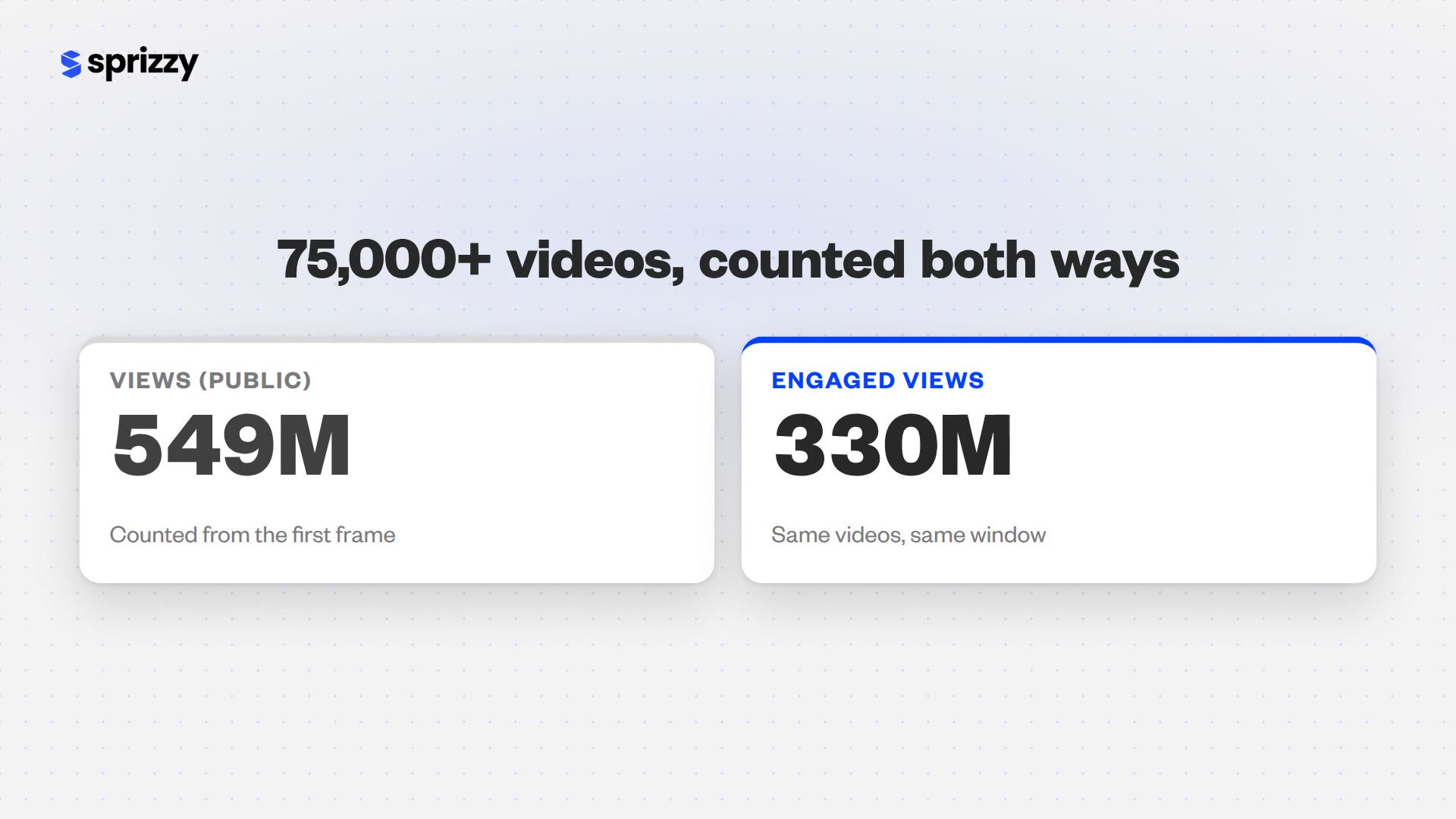
Expect the public number to run well above engaged views, especially on small channels. Agentio, a creator advertising platform, analyzed more than 75,000 videos from its creator network in a September 2026 study and found that only about 6 in 10 public views also qualified as engaged views, meaning public counts overstate attention by roughly 1.67x. For channels under 50,000 subscribers the overstatement was 85%; for channels over 300,000 it was 49%.
Those figures come from Tubefilter’s September 4, 2026 report on the Agentio dataset (549 million public views versus 330 million engaged views). Agentio’s pre-launch estimate, based on 35,800 long-form videos from June and July 2026, had predicted a milder lift of about 30%, so the real-world gap turned out larger than the forecast.
The engaged share also varies by niche. From the same September 2026 analysis:
| Category | Share of public views that were engaged |
|---|---|
| Education | 63% |
| Entertainment and culture | 60% |
| Food and drink | 59% |
| Fashion, beauty, lifestyle | 57% |
| Gaming | 56% |
| Fitness | 52% |
| Technology | 46% |
Where does the inflation come from? Feed surfaces. Agentio found that Home-page hovers, autoplay, and recommended shelves produced 38% of all public views but only 20% of those became engaged views, which accounts for 77% of the entire gap. In plain terms: the new counter is mostly measuring people who saw your thumbnail start moving and kept scrolling.

Does the change affect monetization, watch hours, or the algorithm?
No. YouTube states that the change “won’t impact your YouTube Partner Program (YPP) earnings or eligibility,” and that earnings will still be based on engaged Shorts views and engaged watch hours. Eligibility still uses qualified views and watch hours, so the upcoming 8,000 watch hour threshold is measured exactly as before. Recommendations are also unchanged; YouTube’s post says plainly, “There’s no change to recommendations.”
This matters because the two announcements landed within two weeks of each other and are easy to conflate. The view count change makes your public numbers larger. The Partner Program change, effective February 1, 2027, makes the qualifying bar higher. Neither one moves the other. If you are working toward monetization, the checklist in our YouTube monetization requirements guide still applies, and inflated public views will not get you there faster.
One practical consequence: a Short or a long-form video can now show a large public view count while its engaged views, watch time, and revenue stay flat. If you see views climb without any movement in watch hours or estimated revenue, that is the new definition at work, not a broken dashboard.
How should you read your analytics after August 24?
Treat August 24, 2026 as a measurement break. Any chart of public views that spans the change will show a step up that has nothing to do with your content. For before-and-after comparisons, use engaged views only. For everything else, keep steering by the metrics YouTube says are unaffected: click-through rate, average view duration, retention curves, and subscribers gained per video.
The gap between the two numbers is itself a useful diagnostic. Divide engaged views by public views for each recent video:
- Ratio well above your channel average: the video earns deliberate clicks from search, subscriptions, or external links. Packaging and hook are doing their job.
- Ratio well below average: the video is getting autoplayed in feeds and abandoned in the first seconds. Look at the opening three seconds and the thumbnail-to-content match before blaming distribution, then rebuild that opening with our guide to scripting a YouTube video that keeps people watching.
- A sudden ratio drop on an older video: YouTube likely started pushing it to Home-page shelves. That is good exposure, but judge it by engaged views and retention, not the headline count.
If you have been tracking growth in a spreadsheet, add an engaged views column now and backfill it from Advanced Mode. Because engaged views is the original metric, your historical rows stay valid. Our older guide on what to do in the first hours after publishing still holds, with one update: judge that first-day push by engaged views.
What does the new view count mean for brand deals and sponsorships?
Sponsors will ask which number you are quoting; answer before they do. Agentio’s warning is blunt: “Any Brand partnering with a Creator based on public views is likely overpaying by 67%. A $30 CPM on public views is an effective $50 CPM on engaged views.” Brands that know this will price on engaged views. Creators who volunteer engaged views up front look more credible than those who wait to be caught.
YouTube framed the change partly as a negotiating aid. Tubefilter’s August 18 coverage quotes YouTube saying parity across formats helps creators express “their true scale and value to brand partners and sponsors.” Advertisers interviewed by Digiday were more cautious; Mondo Metrics CEO Nick Cicero warned that “reported economics can improve without underlying audience behavior changing.”
A workable approach for a small or mid-size channel in late 2026: put both numbers in your media kit, label them, and lead with engaged views, average view duration, and audience retention. Engaged views exist only inside YouTube Studio and permissioned reporting tools, so a screenshot of your Advanced Mode table is now a genuine differentiator when a brand cannot see it from the outside.
Since August 31, 2026 there is a third number to label: Views (Co-Viewed), YouTube’s private estimate of how many people watched your video together on a TV screen. It belongs in the same media kit, next to engaged views and marked as an estimate, and it changes neither earnings nor Partner Program eligibility.
Do views from YouTube ads count as views or engaged views?
Paid views clear a far higher bar. Per Google’s help page on YouTube ad view metrics, a skippable in-stream ad counts a paid view only after 30 seconds (or the whole video, if shorter) or a click. In-feed ads count on a click-through or 10 seconds of inline autoplay; Shorts ads count at 10 seconds. Paid views are included in your public view count and, by definition, land well past “the initial seconds.”
That is worth knowing if you are considering paid promotion to get a video in front of people. A view you bought through Google Ads represents someone who chose not to skip for at least 10 to 30 seconds, which is closer to an engaged view than to a first-frame autoplay. Tools like Sprizzy promote your video through YouTube’s official ad platform (Google Ads) and let you target by keywords, similar channels, location, age, and gender, and the resulting views are verifiable in your own YouTube Studio analytics. Note that ad views do not count toward the watch hours required for monetization, so treat promotion as a way to reach a new audience, not as a shortcut to the Partner Program. For what actually happens to a channel after a paid campaign, see our results write-up on whether YouTube ads hurt your channel’s organic growth.
The short version for September 2026: your public view count just became a reach metric. Engaged views is the attention metric, it is the one YouTube pays on, and it is the one to build your strategy around.
Common questions
Did YouTube change how views are counted?
Yes. Since August 24, 2026, a public view is counted the moment a video starts playing, from the first frame, across long-form, Shorts, podcasts, and live streams. The previous, stricter definition was renamed engaged views and is still available inside YouTube Studio Analytics. YouTube announced the change on August 19, 2026.
Will old videos get a higher view count retroactively?
YouTube described the new definition as applying going forward and did not announce a recount of existing videos. Older videos keep the views they already had and accumulate new plays under the first-frame rule, so a long-running video's lifetime count mixes both definitions. Use engaged views in Analytics if you need a consistent series.
Do engaged views affect the YouTube algorithm?
YouTube says there is no change to recommendations. The algorithm never keyed off the public counter; it uses signals like click-through rate, average view duration, retention, and satisfaction surveys, and YouTube confirmed those metrics are still calculated on the engaged-view basis. A bigger public number does not earn more distribution on its own.
Why did my views jump but my subscribers and revenue did not?
Because the public view count now includes autoplay previews and feed impressions that start playing, while subscribers, watch time, and revenue still depend on people who actually keep watching. Agentio's September 2026 analysis found only about 60% of public views were engaged views, and the gap was widest on channels under 50,000 subscribers.
Do Shorts views work the same way?
Shorts were already counted from the moment they started playing in the feed, so the August 2026 change mainly brought long-form, podcasts, and live streams in line with Shorts. Shorts monetization still uses engaged Shorts views, and YouTube Analytics shows engaged views for Shorts excluding loops, so a replay does not count twice.
Do paid ad views count toward my public view count?
Yes. Google's help documentation states that views from skippable in-stream, in-feed, and Shorts ads are included in the public view count. Those paid views require 10 to 30 seconds of watching or a click, so they sit well above the first-frame threshold. Ad views do not count toward the watch hours needed for Partner Program eligibility.