
Getting to 100 subscribers is the part of YouTube nobody makes a highlight reel about. There is no algorithmic shortcut at this stage, no reward waiting at the milestone, and no honest service that can sell you the number. What works is a topic you can keep making videos about, enough uploads to actually get good, and the habit of fixing one specific thing every time. Here is what that looks like in 2026.
How long does it take to get your first 100 YouTube subscribers?
Months rather than weeks, for almost everybody. YouTube publishes no timeline and promises none. Most channels need somewhere between 10 and 30 uploads before subscribers start arriving at any kind of steady rate, because the early videos are where you learn framing, audio, pacing and editing. Treat 100 as the point where you have learned to make the video, not as a prize for showing up.
The persistence stories are real. Marques Brownlee, whose channel sits above 21 million subscribers as of September 2026, was still counting his audience in dozens when he published his hundredth video in 2009. Retellings put the exact figure at anywhere from 70 to 79, so the honest version is simply this: it was under 80, after 100 uploads, for a creator who went on to become one of the biggest technology reviewers on the platform.
That is not an argument for making 100 mediocre videos. It is an argument against reading anything into your first ten. If you are three uploads in and stuck at nine subscribers, nothing has gone wrong yet.
What does 100 subscribers actually unlock on YouTube?
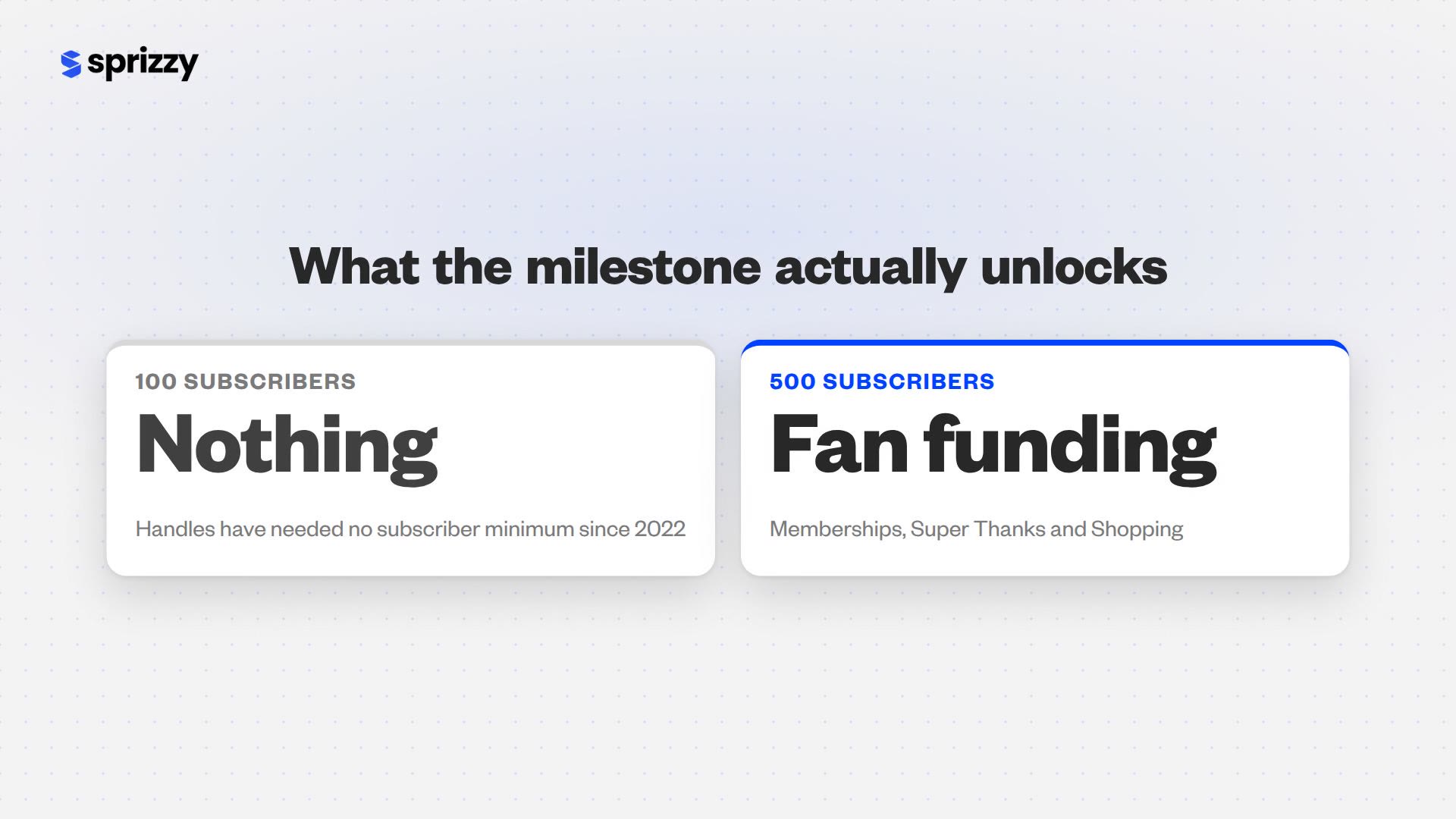
Nothing. This is the single most common piece of outdated advice on the topic. Reaching 100 subscribers used to unlock a custom channel URL, but YouTube replaced custom URLs with handles in late 2022, and every YouTube user can pick a handle regardless of size. New custom URLs can no longer be created at all.
The first threshold that changes anything is 500 subscribers. Here is what the real ladder looks like.
| Milestone | What it actually gets you |
|---|---|
| Any channel | A handle and its youtube.com/@handle URL. No subscriber minimum. |
| Any verified account | Custom thumbnails, which need account verification rather than a subscriber count. |
| 500 subscribers | The Partner Program fan-funding tier: 500 subscribers, 3 valid public uploads in 90 days, plus 3,000 watch hours in 12 months or 3 million Shorts views in 90 days. Unlocks memberships, Super Thanks and Shopping. |
| 500 to 500,000 subscribers | Your long-form uploads can receive Hype from viewers during their first 7 days, if you are in the Partner Program. |
| 1,000 subscribers | Ad revenue, with 4,000 watch hours in 12 months or 10 million Shorts views in 90 days. Our guide to what you need to monetize on YouTube covers the 2027 changes to those numbers. |
How do you pick a niche and the audience inside it?
Pick a subject you could make 50 videos about without resenting it, and that has people already searching for it. Then narrow once more, to a specific viewer rather than a topic. “Weight loss” is a category. “Strength training for women over 40” is an audience, and an audience is what subscribes, because a subscription is a bet that your next video will also be for them.
YouTube’s own guidance on turning casual viewers into regulars points the same way: it recommends consistency in topic and format, with recognizable hosts, plus series built on topics that already worked. A channel that swings between three unrelated subjects gives nobody a reason to expect anything.
Worth checking before you commit: whether brands sell anything to that audience. It has no effect on how fast you reach 100, but it decides whether the channel is worth anything at 10,000.
How many videos should you publish before expecting subscribers?
Plan for at least 10 to 20 before you judge anything, and expect the first few to be the worst work you will ever publish. Every one of them teaches you something concrete: where to sit relative to the camera, how loud the music should be, where the boring 20 seconds is. You cannot learn those things by planning. You learn them by publishing and watching the retention curve.
Keep them short while you are learning, not because YouTube rewards short videos, but because a shorter video is a faster loop. YouTube states plainly that there is no universal ideal length, and that it depends on your content, audience and purpose. Five tight minutes you finish beats a 20-minute cut you abandon.
On cadence, weekly is a reasonable target, but not because the algorithm counts your uploads. YouTube says directly that growth in views across uploads is not correlated with time between uploads, and that taking a break will not damage your channel. Pick the schedule you can hold for six months.
Should you make Shorts or long videos to get to 100?
Both, and a subscriber counts the same either way. Shorts run up to 3 minutes and reach strangers far faster than long-form does on a brand new channel. Long-form is what converts a stranger into somebody who watches you on purpose. YouTube confirms that experimenting with formats such as Shorts, livestreams and long videos will not inherently confuse the algorithm.
The practical approach on a small channel is to use Shorts for reach and long-form for depth, then let the data decide. YouTube Studio has a Subscription source report that breaks your new subscribers down by videos, Shorts, live streams and posts, so you can see which format is actually earning them instead of guessing. Find it under Analytics, then See more, then Subscription source.
One caveat worth knowing early: Shorts are excluded from both Hype and YouTube’s title and thumbnail testing tool, so a Shorts-only channel gives up some of the platform’s growth features.
What should you fix on every single upload?
One thing, deliberately chosen, reviewed after the video is live. The fastest-improving small channels are not the ones with the best gear; they are the ones that watch their own video back honestly and pick the single worst part of it. Run this checklist after each upload and fix the item that fails hardest.
| What to check | What good looks like | Where to look |
|---|---|---|
| The opening | The people who clicked are still there after 30 seconds | Audience retention graph in YouTube Studio |
| Thumbnail and title | Together they make one clear promise the video keeps | Test & Compare, once advanced features are enabled |
| Audio | Speech is clear and level, no room echo, music sits under it | Headphones, before you publish |
| Length | The video ends when the point ends | Your own edit |
| Calls to action | You asked once, at a moment the viewer was enjoying it | Your script |
| Subscribers gained | You know which upload earned them and why | Subscription source report |
Test & Compare lets you run up to three titles and thumbnails against each other and keeps the one with the highest watch time share, usually within two weeks. It needs advanced features turned on and a desktop browser, and it does not work on Shorts or Premieres.

What can you learn from the biggest channel in your niche?
Structure, not style. Open their channel, sort the videos by most popular, and look at what the top ten have in common: the shape of the title, what the thumbnail shows, how long the videos run, what the first 15 seconds does. Those patterns are a free audience-research report, already validated against the exact viewers you want.
Copy the structure and bring your own angle. Copying the look gets you a worse version of a channel people already watch. If you want the mechanics behind why some of those videos surface in search at all, our guide to ranking a YouTube video in search covers what YouTube says it actually measures.
Does branding matter before you have 100 subscribers?
Less than the first 30 seconds of your video, but more than nothing. Consistent colours, fonts and thumbnail composition make your uploads recognizable in a crowded feed, which matters most for the people who have watched you once and are deciding whether to do it again. A logo and a channel banner will not move your subscriber count on their own.
Spend an afternoon on it, not a month. Pick two colours and one font, build a thumbnail layout you can reproduce in five minutes in a free tool like Canva, and reuse it. Consistency is the point, not artistry. If your videos are unrecognizable from each other, work on that before you commission a logo. The mistakes that keep small channels small are almost never branding mistakes. For the rest of the setup work that can safely wait, see what a new YouTuber should ignore in year one.
Can you pay to reach 100 subscribers faster?
You can pay for views. You cannot honestly pay for subscribers. Advertising puts your video in front of people who match your audience, and whether any of them subscribe depends entirely on the video. Anyone selling a guaranteed subscriber count is either using bots or counting on you not checking, and both put your channel at risk.
YouTube is direct about the trade-off. Its own promotion tool documentation states that watch hours and subscribers gained through ad campaigns do not count towards Partner Program eligibility thresholds, and, in the same document, that promotions do not affect your channel’s organic performance. So ads can find you an audience, but they cannot shortcut monetization, and they will not hurt your reach either. We looked at that second question in detail in do YouTube ads hurt your channel’s organic growth.
If reach is the bottleneck rather than the video itself, paid promotion is a reasonable experiment. You can test it with a small budget. Sprizzy campaigns start at $50 and come with a money-back guarantee on your first campaign. What it buys is real viewers through Google Ads, not a subscriber number, and the video still has to earn the click on Subscribe.
Before you spend anything, make sure you are doing the free work first. Sharing every upload off-platform, replying to every comment and pinning a real question still moves a channel of this size more than a budget does, and our guide on what to do after uploading a YouTube video walks through that checklist.
Common questions
How long does it take to get 100 subscribers on YouTube?
There is no published timeline. Most new channels take months and somewhere between 10 and 30 uploads before subscribers arrive steadily, because the early videos are where you learn pacing, audio and packaging. Speed depends far more on how specific your topic is and how often you publish than on any setting inside YouTube Studio.
What do you get at 100 subscribers on YouTube?
Nothing, as of 2026. Reaching 100 subscribers once unlocked a custom channel URL, but YouTube replaced custom URLs with handles in late 2022 and every user can claim a handle at any size. The first threshold that changes anything is 500 subscribers, which opens the Partner Program's fan-funding tier alongside upload and watch-time requirements.
Do Shorts count toward your subscriber count?
Yes. A subscriber gained from a Short is identical to one gained from a long video. Shorts run up to three minutes and usually reach new viewers faster on a small channel, while long-form is better at turning those viewers into regulars. YouTube Studio's Subscription source report shows exactly which format earned your subscribers.
How often should you upload to reach 100 subscribers?
Whatever cadence you can hold for six months. YouTube states that growth in views across uploads is not correlated with time between uploads, so a rigid schedule is not an algorithm lever. Weekly is a common, workable target because it produces enough videos to learn from without pushing you into burnout or thin content.
Can you buy 100 YouTube subscribers?
Not legitimately. Services selling a guaranteed subscriber count deliver bots or spam accounts, and YouTube's fake engagement policy bans artificially inflating subscribers, with strikes and channel termination as the penalty. It also says terminated and spam accounts do not count toward your totals, so the number you paid for can simply disappear.
Why do I get views but no subscribers?
Usually because the video satisfied a one-off curiosity rather than showing what your channel is for. Viewers subscribe when they can predict what the next video will be. Check the Subscription source report to see which uploads actually convert, make more of those, and make sure each video signals what the channel covers.
What is the fastest legitimate way to get to 100 subscribers?
Narrow your topic until it describes one specific viewer, publish 10 to 20 videos on it, and share every upload off-platform where that viewer already spends time. Fix one weakness per video, using the retention graph to find it. Nothing about that is fast, but it is the only route that keeps the subscribers you get.